Are bank bonuses taxable? In most cases, yes. The cash a bank pays you for opening an account and meeting its requirements is generally treated as interest income, which means it belongs on your tax return in the year the bank credits it — even if the bank never sends you a form for it. That catches a lot of people by surprise in January, when the 1099s start arriving.
This guide covers the short answer, which form to expect — 1099-INT or 1099-MISC — what changed for 2026, and how to keep records so tax time is a quick match-up instead of a scramble.
Are bank bonuses taxable? What the IRS says
The IRS treats a bank bonus as interest. IRS Publication 550, Investment Income and Expenses, says that noncash gifts or services you receive for making deposits or for opening an account may be reported to you as interest income on Form 1099-INT, and a cash bonus is reported the same way. The bonus is taxed at your ordinary income rate, in the year it becomes available to you — the year the bank credits it to your account, not the year you opened the account. That timing rule comes from IRS Topic No. 403, Interest Received: most interest that is credited to an account you can withdraw from without penalty is taxable income in the year it becomes available.
A bonus is not a gift in the tax sense. A gift has no strings attached; a bonus always does — open the account, deposit a minimum amount, keep it there, set up direct deposit. The bank is paying you for the use of your money, and that payment is interest income.
Noncash bonuses are taxable too. Publication 550 sets the line by the size of your deposit: for deposits of less than $5,000, gifts or services valued at more than $10 must be reported as interest; for deposits of $5,000 or more, the line is more than $20. The value is the cost to the bank, not the retail price — so a tablet the bank bought for $120 counts as $120 of interest even if it sells for $199.
Credit card rewards work differently, and the contrast is worth knowing. Rewards you earn by spending are generally treated as a rebate on what you bought, not as income, so they usually are not taxed. A bank bonus is not tied to spending, so the rebate logic does not apply to it.
1099-INT vs 1099-MISC: which form you’ll get
Most banks report an account-opening bonus on Form 1099-INT, in box 1 (Interest Income), once your interest for the year reaches $10. The IRS instructions for Form 1099-INT tell banks to include amounts of $10 or more “whether or not designated as interest,” so the bonus usually lands in the same box as the regular interest your balance earns. If you opened accounts at three different banks and collected a bonus from each, expect a separate 1099-INT from every bank.
Some banks use Form 1099-MISC, box 3 (Other income), instead. Which form you get depends on the bank, and the form type does not change whether the money is taxable — it only changes where the amount goes on your return.
One thing changed for 2026: the 1099-MISC reporting threshold rose from $600 to $2,000 for tax years beginning after 2025, per the IRS Instructions for Forms 1099-MISC and 1099-NEC (Rev. December 2026). A $400 bonus reported on a 1099-MISC may no longer generate a form at all. The 1099-INT threshold did not change — it is still $10. And a referral bonus, for bringing in a new customer, is usually reported as other income too, on a 1099-MISC or occasionally a 1099-NEC, depending on how the bank classifies it.
What if you never get a form?
Report the bonus anyway. Topic No. 403 is blunt about this: you must report all taxable interest on your federal return, even if you do not receive a Form 1099-INT. A bonus under $10 is still taxable interest, and a bonus under the 1099-MISC threshold is still taxable other income. The form is the bank’s reporting duty; the income is yours to report either way.
One more form-related surprise: if you never gave the bank a valid taxpayer identification number on Form W-9, the bank must withhold 24% of your bonus and interest payments and send it to the IRS as backup withholding. That withheld amount shows up in box 4 of your 1099-INT, and it counts as tax you already paid.
Which tax year does a bonus belong to?
The year the bank credits it and makes it available to you, not the year you opened the account. A bonus you earned in late 2026 but that is not paid until January 2027 goes on your 2027 return. This is the same rule that applies to ordinary interest: it is taxable when it is available, whether or not you withdraw it.
Banks generally must furnish your copy of a 1099 by January 31. For the 2026 tax year, January 31, 2027 falls on a Sunday, so your copies are due February 1, 2027. If a form you expect has not arrived by then, check the bank’s online tax documents first — many banks post them there before anything arrives by mail.
How to report a bank bonus
The form tells you where the amount goes:
- 1099-INT, box 1: add it to your taxable interest on Form 1040, line 2b. If your total taxable interest for the year is over $1,500, list each payer on Schedule B.
- 1099-MISC, box 3: report it as other income on Schedule 1.
Add up every bank’s forms — the IRS gets a copy of each one, so your return should match the total. And because this is general information, not tax advice, talk to a tax professional about your own situation, especially if you collected several bonuses, closed accounts, or received a form you were not expecting.
Keeping records so tax time is painless
If a bonus does not show up on a 1099, or a 1099 shows an amount you do not recognize, the first thing anyone will ask is when the bonus was paid and how much it was. A simple record makes that conversation short. For each bonus, note:
- The bank and the account
- The amount and the date it was credited
- Which form arrived, and the amount on it
- The tax year it belongs to
This is what BonusLedger’s 1099 tracking is for. Each account has a 1099 section where you keep a per-year record: the tax year, whether the form has been received, the reported amount, the date it arrived, and notes. Records carry a status — Pending, Overdue, or Received — with January 31 deadline warnings and overdue detection, and a badge on the account’s Overview tab shows how many forms are still outstanding. The Tax Summary totals your reported bonuses across accounts and years, and it always stays gross: fees you logged do not reduce it, so the total matches what the banks report. You can also store the 1099 itself with the account as an encrypted document — 1099 forms are one of the document types, and high-risk documents need Face ID to open.
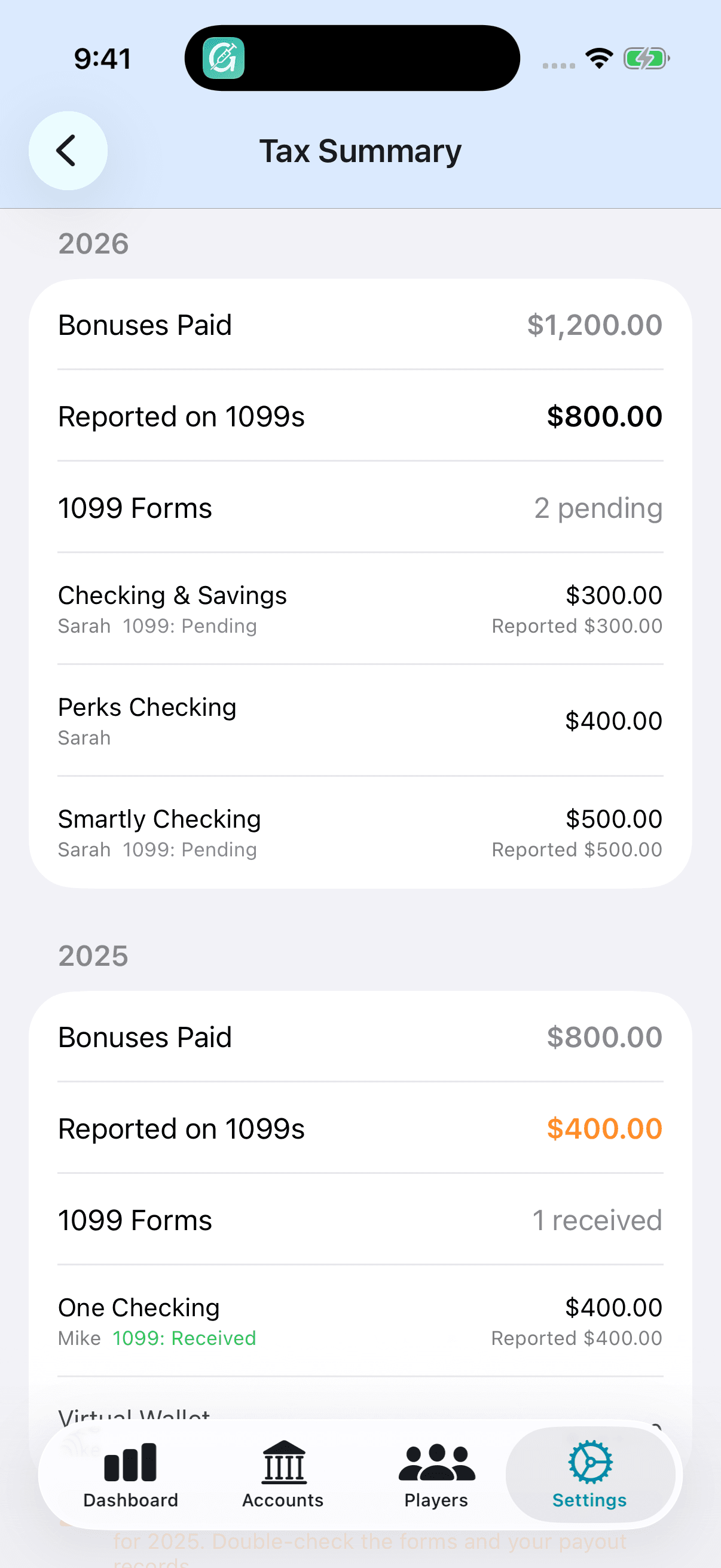
BonusLedger also warns you about bonuses with no 1099 recorded yet, so a missing form stands out before January ends instead of after you file. New to tracking? Our step-by-step guide, how to track multiple bank bonuses without a spreadsheet, walks through setting up your first account, and what counts as a direct deposit covers the requirement most bonuses hinge on.
A January checklist
- Check each bank’s online tax documents against your records.
- Match every 1099-INT and 1099-MISC against the bonuses you logged.
- Chase any missing form for a bonus of $10 or more — but do not wait for the form to report the income.
- Save copies of the forms with your tax records.
Frequently asked questions
Are bank bonuses taxable?
Yes, in most cases. The IRS generally treats a cash bonus for opening an account and meeting its requirements as interest income, taxed at your ordinary rate in the year the bank credits it.
Will I get a 1099-INT or a 1099-MISC for a bank bonus?
Most banks report the bonus on Form 1099-INT, box 1, once your interest for the year reaches $10. Some banks use Form 1099-MISC, box 3, instead. Either way, the bonus is taxable income.
Do I have to report a bank bonus if I didn't get a 1099?
Yes. The $10 and $2,000 figures are thresholds for when the bank must send a form, not for when you owe tax. Report the bonus even if no form arrives.
When will my 1099 forms arrive?
Banks generally must furnish your copy by January 31. For the 2026 tax year, January 31, 2027 falls on a Sunday, so copies are due February 1, 2027.
This article is general information, not financial, tax, or legal advice. Bank offers and their terms change often and differ between banks, so always read the current terms from your bank, and talk to a tax professional about your own situation. BonusLedger is not affiliated with, endorsed by, or paid by any bank or financial institution mentioned on this site.